
Nautilus is a first-person underwater exploration game where the player descends into the deep inside a submarine, navigating tight caves and submerged ruins. The focus is on atmosphere, discovery, environmental storytelling, and environmental tension using darkness, scale, and sound to sell the pressure of the abyss.
This project began as a VR prototype concept. I later brought it back as my Personal Project 2 during school, where I scaled it into a shippable first-person experience. From there, I pitched it to my school for Game Project 3 and got the opportunity to take it into full production.
Built in Unity, Nautilus was developed as a multi-discipline student project under a tight deadline. I worked on level blockouts and pacing, submarine layout and onboarding, and owned much of the FMOD audio implementation and sound design. I also provided secondary programming support to help the team ship.
Core idea
Level Design:
Designed the level flows, focusing on low-visibility navigation, clear landmark routing, and player mood.Submarine Layout:
Worked on the submarine experience and onboarding, including layout/flow decisions that support readability and the “commitment” moment when exiting the sub.Audio (FMOD):
Owned most of the audio implementation using FMOD in Unity, placing triggers/areas and building transitions to support mood and navigation. Did additional sound design edits in Audacity and recorded AI assistant voice lines.Programming Support:
Helped with smaller programming tasks when needed to reduce team workload and keep production moving.Team Coordination:
Checked in with teammates, tracked what was blocked/next, helped distribute tasks, and set up quick meetings and playtests to keep momentum.
Core idea
This chapter explains how Nautilus evolved from an early VR concept into a shippable first-person project,
and why I pitched it as a full production for Game Project 3.
The first version of Nautilus started as a VR co-op concept inspired by Subnautica’s exploration and the team-based structure of Deep Rock Galactic.The goal was a submarine crew fantasy, with multiple roles working together while facing the unknown.I originally explored this idea before joining PlaygroundSquad, during my previous education.
Early tests made the scope problem clear: VR + multiplayer + role systems was too heavy for a student production.
Instead of forcing it, I kept the strongest part of the idea, the descent atmosphere and underwater mystery, and rebuilt the project around a smaller, shippable core.
For my Personal Project 2, I returned to the concept to prototype the experience in a simpler format.This phase was about proving the core: the feeling of being sealed inside a submarine, guided by sound and limited visibility, with environmental storytelling pulling the player forward.
Once the core fantasy was clear and feasible, I pitched Nautilus to my school for Game Project 3.
The project was selected, and the focus shifted from “big systems” to a deliverable experience:
Strong pacing, readable spaces, and audio-driven atmosphere.
Inspiration
My biggest references for the GP3 version were Subnautica and Disney’s Atlantis: The Lost Empire (2001).
Subnautica gave me the emotional arc I wanted, curiosity pulling the player forward while the deep slowly turns into fear.
Atlantis helped me communicate that adventurous mystery in the pitch, so the tone was clear instantly.To keep the experience readable and tense, I treated inspiration as a set of rules.I built contrast between tight routes and reveal spaces, used landmarks to imply story without dialogue, and relied on sound to support navigation so the submarine never feels silent or dead.
Level Design
Designing Nautilus meant solving a core challenge: underwater spaces are easy to get lost in, especially when the player travels by submarine and then exits to explore on foot. This chapter breaks down how I approached onboarding, route readability, and pacing to make short distances feel heavy and meaningful.
Level 0 / The Onboarding
Our first onboarding layout was too tight for a submarine game. Teaching driving and parking in a compressed space made the opening feel stressful and unclear.
The player was dealing with controls before they had any mental map of the environment.To solve that, we moved the start outside. This gave the player space to read the scene first, then approach the submarine with intention.The airlock became the first clear threshold, a moment that signals “you are entering the mission” before the descent begins.
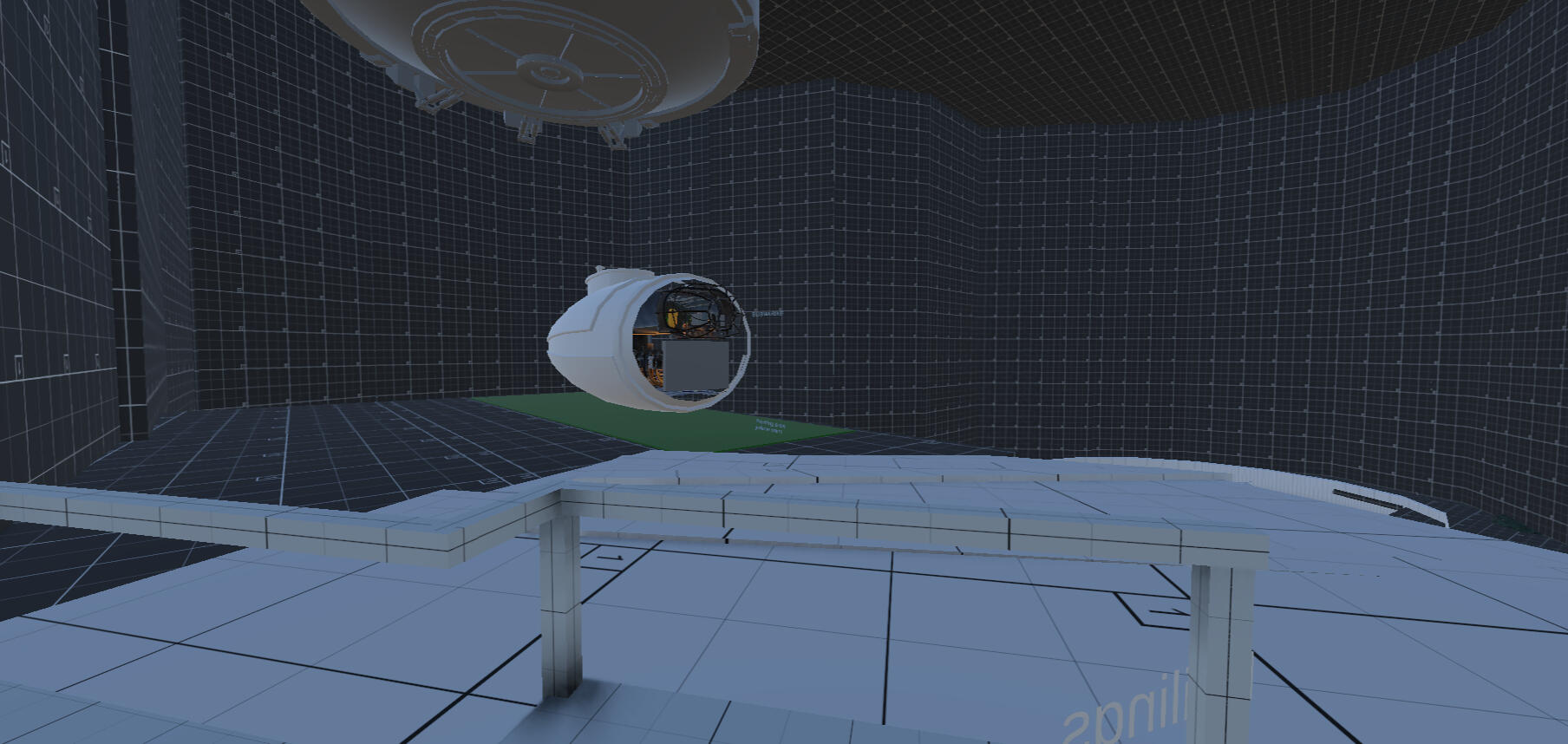
Level 0 is designed to make short distances feel heavy. The player walks toward the submarine while the world stays quiet and low visibility keeps the space tense.


Even before driving, the player starts learning navigation by reading silhouettes, lights, and the path.Most importantly, the level frames the goal early. While approaching the sub, the player can also see the large drop in the background.That is the promise of the level: “this is where you are going next.” It turns the start into a mission setup instead of a random spawn.
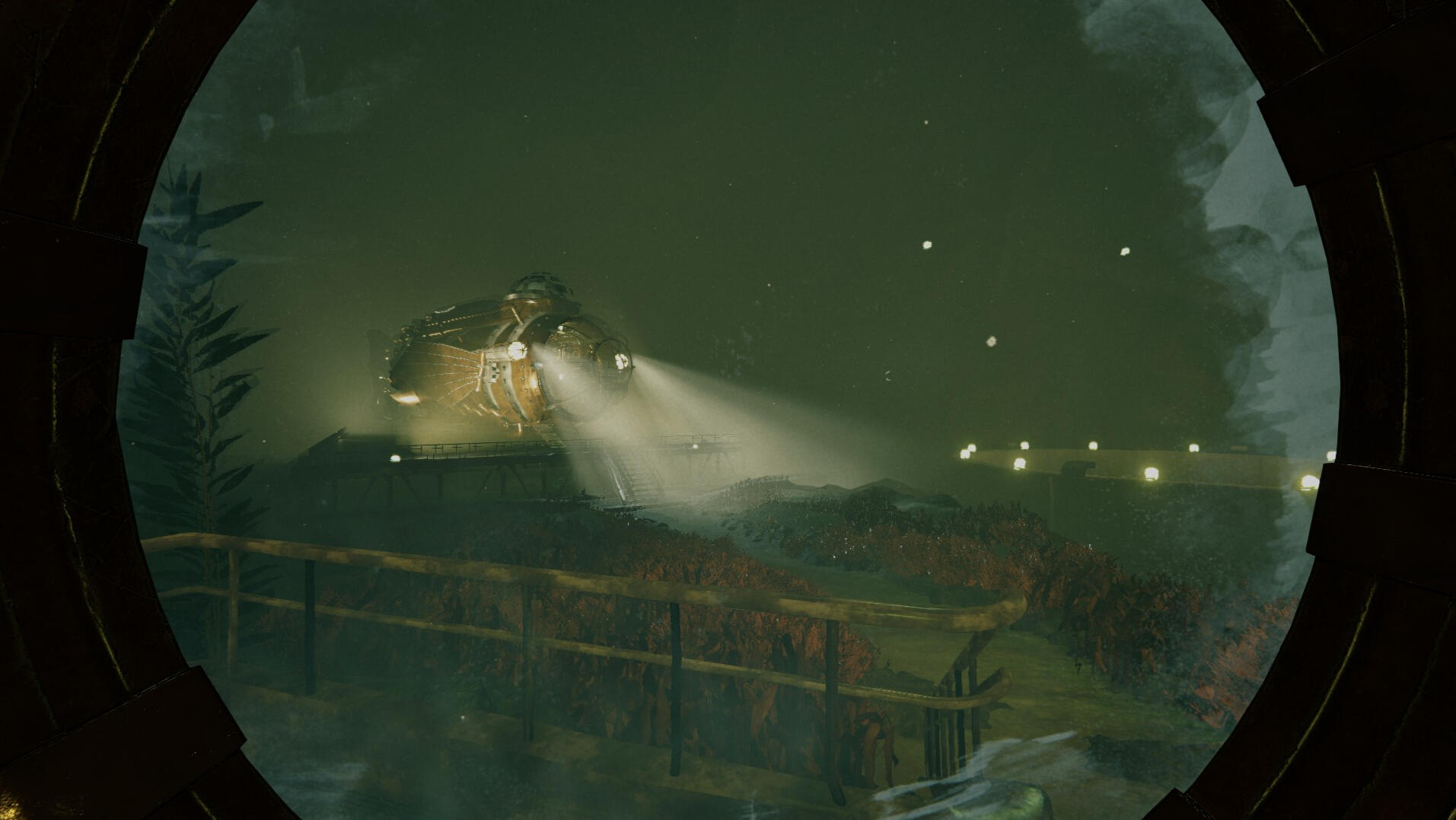
Level 1 / Arrival
Level 1 is a low-visibility navigation test designed to feel vast at first, then become readable through landmarks
and tool-based navigation.
•Submarine Area
After the drop, the player is dropped into darkness with limited visibility, so the space has to guide them without clear sightlines.
I shaped the submarine route as a simple oval loop that feels huge at first, then becomes legible as the player reaches key landmarks and a safe landing zone.The goal was to create:
“Lost at first → oriented later” without long UI handholding.

In early blockouts, the cave played too large because movement tuning wasn’t final yet, a classic vehicle-level bottleneck.Once handling stabilized, I narrowed and shortened the route and supported it with more lighting, aligning with environment art so the space stayed feasible and the pacing didn’t drag.

•Walking Area
The walking segment is a deliberate vulnerability beat: leaving the submarine makes the player feel exposed, so the route is tighter and goal-driven.
The walking segment is a deliberate vulnerability beat: leaving the submarine makes the player feel exposed, so the route is tighter and goal-driven.I structured it around a clear lever-room objective and readable path edges, so the player always understands where the submarine is and what they’re working toward.

Playtesting showed the return path after the lever was too long and killed tension.In a team brainstorm, we redesigned it into an escape sequence:
The cave collapses on the way back, and the submarine autopilot meets the player on the other side for pickup.That turned boring backtracking into a high-pressure moment while the player is outside and unprotected.


Level 2 / The Bowl
Level 2 is a pacing bridge, a longer submarine sequence that shiftsthe player from fear to wonder before the next
objective-heavy section.
During production this section was originally planned as a later level, but in playtests we realized it fit better before the next parking beat.
The problem was pacing.. Stopping again too soon made the adventure feel segmented, and we needed more uninterrupted driving time where players could practice navigation and feel the scale of the world.
My solution was to turn “the Bowl” into a guided discovery space, short in distance but huge in presence.The electric-field entry frames a magical biome reveal (inspired by Subnautica’s mushroom zones and the “whale” sense of awe), so the player goes from tension to curiosity.The route stays readable through strong silhouettes and landmark architecture (the arches corridor), then ends by pointing the player at a clear goal:A collapsed temple entry and a red passage that acts as the final pull toward Level 3.

The end of Level 2 is built to “close the curtain” on the beauty and convert it into purpose.
After the Bowl, I wanted the player to realize the first door wasn’t the destination, it was a hint.
From the submarine POV, the arches corridor reveals larger structures than expected, pushing the feeling that this place continues far beyond what you’ve seen so far.It’s still readable to navigate, but the main job is emotional “We’re not alone down here, and we’re only scratching the surface.”I framed the corridor as a guided discovery beat: silhouettes first, then scale, then a clear pull forward so the player stays curious instead of lost.
I reused the “collapsed hole” idea from earlier levels, but recontextualized it: not artificial damage from Torsion infrastructure, this time it reads as a natural collapse that exposes more of the ancient site.
That shift matters for the player’s story brain:
It feels like the environment itself is opening up, not like someone built a path for you.The shape language and framing are designed to be unmistakable from a distance, so the player understands: this collapse is the new way forward, and it cleanly hands off into Level 3.
Level 3 / Lava zone
Level 3 is where the world stops feeling “hidden” and starts feeling dangerous. The ruins are out in the open, geysers are active, and the environment feels hostile , more like you entered something you shouldn’t.
•Submarine Area
I shaped the submarine route so the player always has one clear goal: reach a safe landing zone.The cave stays readable by using big silhouettes and a clean approach line, and the submarine assistant helps confirm the direction when the space gets intimidating.From the landing zone, the next objective is already readable: you can sense there is a temple path nearby. The player lands with a clear thought of "I’m going on foot now.”

This blueprint shows Level 3’s submarine route, the cave navigation before you ever go on foot.

After Level 2, I wanted the space to feel tighter and more dangerous, but still easy to read in low visibility.So the cave starts as a narrow squeeze, then opens into one main route that naturally leads into a clear landing pocket.The landing zone is the key moment here:
it’s an obvious “safe spot” inside a hostile biome, and it frames the temple area as the next pull forward.Once the player commits to parking, the level can shift cleanly into the walking section without confusion.

•Walking Area
This blueprint shows the full Level 3 walking loop: land → reach the lever → return to the submarine.
I built it so the submarine stays a constant anchor in the player’s mind, even when they’re on foot in a hostile biome.The route starts readable and safe, then intentionally pushes the player into exposed moments (bridge + cliff edge), and finally funnels into the temple as the clear objective.The important part is the ending, after the lever, the level doesn’t ask for a boring repeat. The mechanism triggers an “earthquake” shift, so the return becomes a fresh, faster route back to the landing zone.

This is where the level turns from “hidden ruins” into open danger. The goal was to make the player feel small and exposed.Stepping onto a bridge, walking along edges, looking down into deep water, all while the temple path stays readable ahead.I used the space to create tension without confusing navigation: the route is basically one strong pull forward, but the environment sells risk.

With my environment artist, we used that setup to introduce a fear moment.
A large creature swims through the player’s frame while they’re on the edge of a path, far away from safety.it’s there to make the biome feel alive and hostile, while the route still pulls you forward toward the temple entrance.

Inside the temple, the pacing slows down on purpose. After the exposed outdoor walk, it turns into a quieter space where the player can take in the scale, read a few story beats, and follow one clear objective: reach the lever.
On early passes, the return trip was the weak part. Once the lever is pulled, the player already understands what it means (they saw this setup in Level 1), so walking the exact same hallway back didn’t add much, it just felt like dead time.So the return is treated like a small twist instead of a repeat. The lever triggers a change in the space, the original way back gets blocked, and the player is pushed through a different exit route.
It keeps the “I’m heading back to safety” goal, but the path feels fresh, and it lands you back at the submarine without dragging the pacing.
Level 4 / Lost City
After the tight caves and pressure in the previous areas, Level 4 is the release. One final push and you suddenly enter something unreal: a forgotten ancient city.
This section is built to feel like a reward. The space opens up, the silhouettes get huge, and the player understands instantly: “I’m finally here.”


•Blockout Pass
Most of the city layout started from another designer, but it needed a pass to fit real playtime. On foot the player moves slow, so distances that look fine on paper can become a drag.I tightened the space, cut the extra detours, and merged in my older “lost city” prototype so the final run stays readable and doesn’t lose momentum.

•Planning the finale
Once the Lost City was locked, we still needed to decide what happens after it. With the deadline getting close, me and the environment artist needed a clear target so we could plan the remaining work without guessing.We sat down, sketched the ending beats, and used it as a quick scale check: how long it feels to walk through, what needs to be seen from far away, and what the city should “say” without dialogue.
The city is built around one simple read: A central gap with the ziggurat rising behind it. As soon as you enter, you already understand where you’re going, you move through the city, not around it.This blockout was also my way to communicate the “feeling brief” to the environment artist: quiet, magical, overwhelming scale, a final run where the place speaks for itself.


Submarine experience
The submarine is basically the player’s body in Nautilus. It’s how you read the caves, how you feel safe, and how you build tension before you ever step outside.This section is a quick project report of my contribution to the submarine experience, from early prototypes to the decisions that shaped how it feels to drive.
Visibility
I researched cockpit references that feel physical, like you’re inside a machine, not a floating camera.The observation blister style from Ashes became a strong direction: a curved front window that limits the view but makes silhouettes and motion outside feel more intense.
I didn’t want “car windshield underwater.” I wanted a framed view that feels physical — like you’re looking out from a protected bubble.
I looked at tight visibility references, especially the Ashes’ observation blister vibe and sci-fi cockpits where the window shapes what you notice.
I blocked out a simple cockpit and tested different window sizes and shapes directly in the caves. I was checking two things:Can the player still navigate by landmarks?
And does the view keep that underwater pressure alive?Once the window started feeling right, I locked it as the baseline so we could build the rest of the submarine around it.
I tested a few window shapes in-engine, and the main change was going from a “wide windshield” feeling to a tighter frame that forces focus.The tighter view made landmarks and silhouettes hit harder, and it kept the caves readable without killing the tension. Once that felt right, the window became the base for the rest of the submarine.
After the global redesign of the whole submarine, the cockpit had to evolve with it.
The goal was clarity, not just in UI, but in feeling.
The new layout gives the player a cleaner read, while keeping them exposed to the environment outside. You’re not sitting in a “safe vehicle”… you’re a tiny human inside a heavy machine, pushing into unknown spaces.The last tweak that made it click was scale:
I increased the steering wheel a lot. Suddenly it felt like you’re controlling something big, not a toy and the cockpit finally matched the vibe of the journey.

Layout
Once the cockpit view clicked, the next step was making the interior flow match the pace of the game. The player walks slowly, so even small confusion or extra distance turns into friction.I simplified the layout into a clear path and readable zones, so the submarine stays a safe anchor instead of feeling like a maze between level beats.


Mid-production, we needed the submarine to support gameplay first: clear interaction zones, readable roles for each station, and a cockpit that frames the outside world. We used a quick whiteboard layout to agree on priorities and avoid “guessing” in 3D.

The exit needed to feel intentional, not accidental. Moving the ramp to the bottom created a consistent landing → step out moment, so leaving the submarine feels like committing to the unknown.It also helped level design, so the player exits from a predictable orientation, so exterior spaces can be framed for mood, clarity, and navigation.

Seeing it in motion confirmed the goal: the ramp slows the moment down in a good way.It gives the player a second to look, listen, and feel exposed before the next area, so the submarine becomes part of pacing, not just a vehicle.
I used a simple film reference to communicate the vibe fast:
a dramatic, staged exit where the player feels small next to the machine.Ours is obviously not comedy, but the body-language of the moment is useful.
Once the exit flow and cockpit roles were locked, I documented the submarine as a readable top-down layout.This made it easier to place interactions consistently and communicate the structure to the team.


Cabin
• Rest/Save (if you have it): A safe reset point between dives.Electrical
• Fuse Box: Restore power after failures (turns core systems back on).Helm
• Steering Wheel: Turn the submarine left/right.
• Speed Telegraph: Set forward/stop/reverse speed.
• Depth Controls / Ballast:
Change depth (descend/ascend).
• Sonar Screen: Scan the area to locate landmarks and points of interest.
• Scout Launcher: Deploy a small scout to check tight spaces safely.
Engine Room
• Engine Switch: Start/stop the engine (enables movement).Airlock
• Airlock Controls: Open/close the airlock sequence for exiting the sub.
• Ramp / Exit: Leaving the submarine
Helm
The new layout gives the player a cleaner read, while keeping them exposed to the environment outside. You’re not sitting in a “safe vehicle”… you’re a tiny human inside a heavy machine, pushing into unknown spaces.The last tweak that made it click was scale:
I increased the steering wheel a lot. Suddenly it felt like you’re controlling something big, not a toy and the cockpit finally matched the vibe of the journey.

Scout
Limited visibility was the core tension of Nautilus, but it also risked turning navigation into guessing. I wanted a tool that keeps the player feeling small and exposed in the cockpit, while still letting them probe the unknown with intent.
The reference point was Outer Wilds: a curious, lightweight “send it out and learn” gadget, more exploration instrument than weapon.That vibe also matched what I enjoy designing: systems that turn uncertainty into curiosity, not frustration.
I built an early scout prototype to test one thing.
Does it help the player read space without killing the mood? I started with a particle-heavy approach because it was the fastest way to sell “a glowing probe drifting into darkness.”It worked for readability, but it didn’t scale, performance cost was too high, and it fought the production deadline.So I treated it as a proof-of-feel, then rebuilt it into a shippable version.
The final scout was fully implemented by me.
I rewired it to a lighter setup, added a timer, and built FMOD audio feedback so the player can track it even when visibility collapses, sound became part of navigation, not just atmosphere.The player stays vulnerable, but they never feel lost for free.You can view some of the cleaned-up C# scripts here:
Scout Mechanic Scripts
Sound
In Nautilus, audio wasn’t just there to make things spooky, it was a navigation tool.Because visibility is limited, sound had to guide the player’s attention, confirm direction, and sell tension without adding UI noise.That meant each space needed its own identity, and transitions had to feel intentional as you move between areas.
I took major ownership of the audio work by learning and integrating FMOD into Unity, wiring events through the levels with trigger volumes so ambience, cues, and moments blend cleanly.I also did sound edits in Audacity, and built the AI assistant voice pipeline by generating lines through a SAPI4 text-to-speech tool, then polishing them in Audacity so the voice sits naturally in the mix and supports key actions like sonar, docking, headlights, and stepping outside.
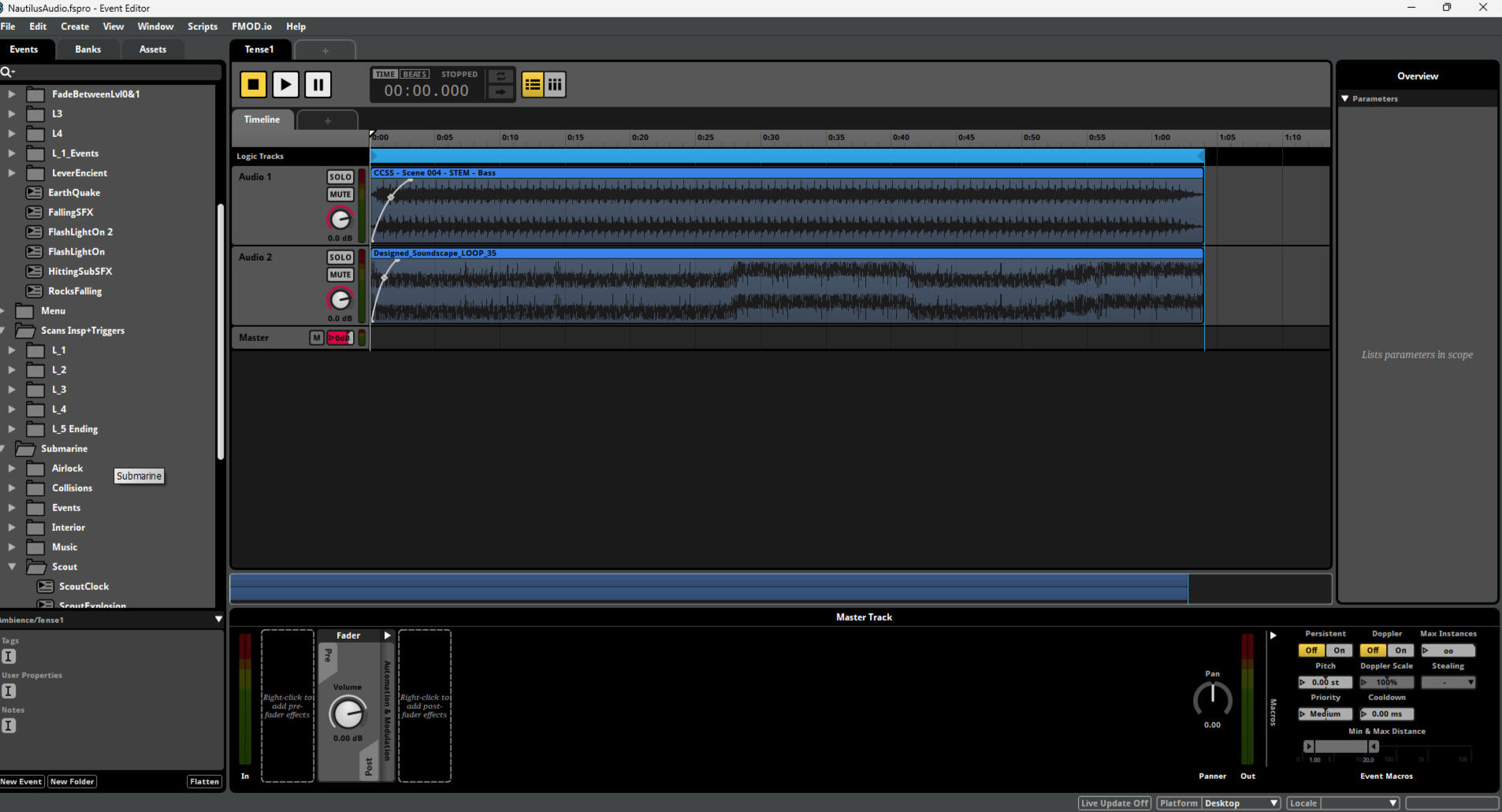
AI RUINED SUBMARINE 🔊
This moment uses the AI assistant as both guidance and storytelling. I wrote and recorded the scan lines, then supported them with layered ambience so the wreck feels “alive” in the dark, the player gets information, but also a strong sense that something went wrong here.
AI RUINED SUBMARINE 🔊
On the way back, the goal was to shift from exploration into relief and momentum.I used pacing-driven ambience changes and transitional audio beats to make the space feel larger and more dramatic at the end of the level, a payoff moment before the player reaches safety again.
Team Coordination
During production, I also supported the team by keeping work aligned, unblocked, and focused on a shippable build.
I regularly checked in with teammates to understand what was blocked, what was next, and what could realistically be finished in time. I kept a simple task list, helped distribute work by asking who could take what, and brought issues to the other leads so we could decide early instead of drifting. When needed, I set up quick meetings and playtests to get answers fast and keep momentum.
Challenges & takeaways
This project taught me how quickly a strong concept can become messy once production starts. Nautilus had a lot of moving parts, and the hardest part was keeping a clear direction while the team was building in parallel.I learned that underwater level design lives or dies on readability. When visibility is limited, you can’t rely on “more content” to make it better. You need strong landmarks, clear objectives, and pacing that doesn’t waste the player’s time.I also learned to be ruthless with scope. We had to cut and reshape ideas to keep it deliverable, and some of the best improvements came from admitting something “cool” wasn’t working in playtests and restructuring it.FMOD was a big personal win for me. I had to learn it fast, implement a lot of audio under pressure, and I realized audio isn’t just polish in a game like this, it can carry navigation, mood, and player confidence when the screen can’t.Finally, I learned what “tough project” really means:
Staying useful when things are unstable. Some weeks were heavy, but I got better at stepping in where needed, finishing work that unblocks others, and pushing the project toward a shippable state.